You are currently working on UAT 

A small TM for each subject VS a big TM for similar subjects? (Need suggestions and advice)

Hi,


What're the best methods for creating and organizing TM and storing them to use for the next projects? As a beginner with Trados Studio; I guess creating a small TM (less TUs) for a subject or a category is better than creating a big TM (more and more TUs) for a few similar subjects.

For example; if I’m going to translate an article about Painting, I’ll create a TM just for it and call it e.g, Painting TM! After that, if I’m going to translate a document about Painting History, I’ll create a specific TM for it, and I think it would be better they'll be separate from each other than merge into one TM.

Maybe it’s not necessary to create a TM for each subject and it’s better to use a big TM that cover similar subjects because there are many similar words, phrases, names, date, and more things that in common with each other.

What do you think and what're your suggestions? Creating and using a small TM for a subject (e.g, MS Word has own TM and MS Outlook has own one, etc..) or creating and using a big TM with a lot of TUs for applying about some similar subjects (e.g. a TM that covers all MS Office software)?

What're the advantages and disadvantages of small TM with less TUs and huge TM with a lot of TUs?


Best,

Masoud

Parents
  • Hello ,

    A sensible way of organizing your TM's I would suggest is by topic/subject.

    You only need different TM's if the subject matter is quite varied.

    As an example, if you translate legal documents -you might like to have one main TM for all the general translations and then a second TM if you do lots of say medical translations and a different TM if you also translate legal documents in the financial sector.

    If you were translating an  MS Office manual- then you could i think quite happily put this all in one TM.

    What however is also important- is to ensure you regularly back up your TM's (and other resources).

    https://appstore.sdl.com/language/app/sdl-tmbackup/869/

    Oana Nagy | QA Engineer | RWS Group

  • Hello

    if I create and use subject-related TMs (e.g. in legal field), is it possible to add customer and project details in TM fields?

    I mean that I would use the, say, legal TM for any legal project regardless of the client but I would like to keep track of the customer and project each segment refers to, is it possible by using TM fields?

    If yes, is there a way to make Trados Studio insert customer and project information into such fields ?

    Kind regards

    Davide

  • Hello

    Kindly tag people in the future as I did here (using the @ symbol + the name), otherwise they do not get notified when you write to them.

    This is a very good question and it is absolutely recommended to differentiate where the content is coming from in your TM.

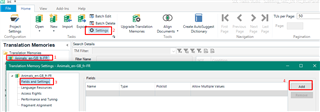
    These are called field values. First, you have to define these values in the given TM's settings in the Translation Memories view:
    Trados Studio Translation Memories view showing the settings button and a highlighted field values section with an 'Add' button.

    Like this for example:

    Close-up of a drop-down menu in Trados Studio with 'Customer A' and 'Customer B' as selectable field values.

    You can define a list to pick values from or choose 'Text' as the type and then you can add the value freely (but might mistype, so I would recommend using pre-defined picklist values wherever possible).

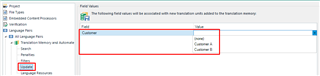
    Once this is set, when you are setting up a new translation project / before you start a new translation, go to the Project Settings > Language Pairs > Translation Memory... > Update to select the values:
    Trados Studio Project Settings window highlighting the field values section with 'Customer' field and values 'None', 'Customer A', 'Customer B'.

    Then once you start confirming segments in the translation thus loading them into the memory (or do a memory update batch task), the segments will be added into the TM with these custom values:
    Trados Studio showing a list of translation units with the 'Customer' field column displaying values 'Customer A' and 'Customer B'.

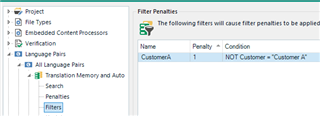
    You can then do several things using these values, for example define filters to prioritize translation units created for 'Customer A' the next time you translate for Customer A. This can be done in the Project Settings > Translation Memories... > Filters:
    Filter Penalties section in Trados Studio Project Settings with a filter named 'CustomerA' applying a 1% penalty to translation units not added with the value 'Customer A'.

    (This filter means for example that every TU that was not added with the value 'Customer A' will be penalized with 1% - can only be 99% match max., so the TUs for Customer A will be preferred.)

    Hope this answers your questions.

    Best wishes,
    Greta

    emoji


    Generated Image Alt-Text
    [edited by: Trados AI at 6:29 PM (GMT 0) on 28 Feb 2024]
  • Hello ,

    thank you very much for your reply and for notifying me about the tag issue. I have corrected it and I will go through the procedure information you described as soon as possible.

    Davide

  • Hello ,

    I have checked the procedure you describe and it looks like exactly what I need, thank you very much!

    Davide

  • Hello ,

    are you also aware of any procedure to do that for TMs used in past projects (not for new project TMs) that I would like to reorganize? Is it possible to achieve it perhaps via the upgrade feature in the Translation Memory pane?

    In other words, would it be possible to aggregate (or to upgrade) past TMs in one new TM so that Trados automatically fill-in customer and domain fields of its segments based on the source (past) TMs?

    Davide

  • Hello

    Upgrading the TM in itself will not help - the functionalities you are looking for is the export/import and the batch editing I believe.

    Are these past TM's customer-specific? Only containing translation units from one customer?
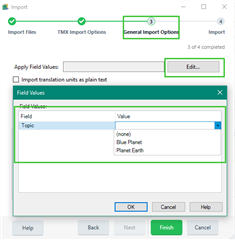
    If so, you can simply export the TM and import it to the new aggregated TM, with defining a field value to apply for all these translation units added with the import:
    Trados Studio import settings window showing the option to apply field values to imported translation units with 'Topic' field and 'Blue Planet' value selected.

    (Of course these values first have to be defined in the settings of the new TM.)

    Then as you run the import, the TUs will be added to the new TM with all the selected values:
    Trados Studio translation memory settings window displaying custom fields with 'Topic' field and 'Blue Planet' value defined.

    In case your past TMs contain TUs from mixed origin, for more customers, it is a bit trickier.
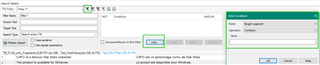
    In this case I would first batch edit them in the past TM, adding the field value to specific segments based on filters. This is only possible of course if a filter can be defined to differentiate between the TUs for different customers.

    The filter has to be defined and saved first:
    Trados Studio batch edit settings window with a filter applied and the option to change field values highlighted.

    It can be the date when it was added, or certain words in the source or target, etc. Whatever you feel works to differentiate. If there are more then 2 customers, more filters have to be defined.

    Then once the filter(s) is/are defined, go to the settings and set up the filed values to apply.

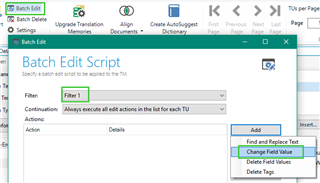
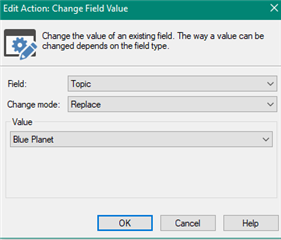
    After this go to Batch Edit and define the what to do, and select the filter so that it would only be applied to the matching TUs:
    Trados Studio batch edit script window showing 'Filter 1' selected and options to add and replace text or change field values.

    Edit action window in Trados Studio for changing field value with 'Topic' field selected and 'Blue Planet' as the new value.

    And then execute it. Once done, the content of the TM can be exported and added to your new aggregated TM.

    This also works without the batch edit: once you defined the filter you can just export the TUs matching the criteria and them import them with adding the field values described above.

    This is a bit labour-intensive but you only have to do this once with your past TMs, and in the upcoming translations you can set the field values before starting the work so the new units would be automatically added with the correct values.

    Hope this helps. In case something is unclear, just let me know.

    Best wishes,
    Greta

    emoji


    Generated Image Alt-Text
    [edited by: Trados AI at 6:29 PM (GMT 0) on 28 Feb 2024]
  • Hello ,

    thank you very much for that detailed explanation. I'll try those instructions as soon as possible.

    My TMs are indeed customer specific.

    Davide

  • Hello ,

    I would like to follow a similar approach, as you described above, with termbases I use for my projects.

    Is there perhaps any Trados feature that makes it possible to automatically assign customer, subject and project details in newly added terms for a termbase?

    For example, let's say I am working on a legal project for customer XXX. I need to use an old legal termbase but I want to update it so that terms I create during the translation process have their "project", "subject" and "customer" fields automatically filled-in with my current project, subject and customer details.

    Is it possible?

    Besides, should I open a new thread so that this termbase-related question doesn't mess up with this thread related to TMs?

    Davide

Reply
  • Hello ,

    I would like to follow a similar approach, as you described above, with termbases I use for my projects.

    Is there perhaps any Trados feature that makes it possible to automatically assign customer, subject and project details in newly added terms for a termbase?

    For example, let's say I am working on a legal project for customer XXX. I need to use an old legal termbase but I want to update it so that terms I create during the translation process have their "project", "subject" and "customer" fields automatically filled-in with my current project, subject and customer details.

    Is it possible?

    Besides, should I open a new thread so that this termbase-related question doesn't mess up with this thread related to TMs?

    Davide

Children