Exporting xlfs from Trados to be compatible with Madcap Lingo - Trados 2022

Hi, 

We recently translated some xlf files in Trados and our client has tried to import them back into MadCap Lingo but is getting the following error 'XLIFF in translation unit 5 is corrupt. Object reference not set to an instance of an object.'

Is anyone able to advise if there are any settings we need to use when handling xlf files in Trados in order to ensure they're compatible with MadCap lingo? I'm using the 2022 version of Trados. 

Thank you very much in advance for your help. 


I'm using the 2022 version of Trados.
[edited by: Sarah Place at 4:56 PM (GMT 0) on 10 Mar 2025]

emoji
  • "Probability score": 0.9

    "Question improvement suggestion": Please provide the exact version of Trados Studio you are using and any error codes if available. Also, mention if there have been any recent changes to the system or software.

    In the meantime, based on the information you have provided, here is a suggested answer to your question:

    Hello,

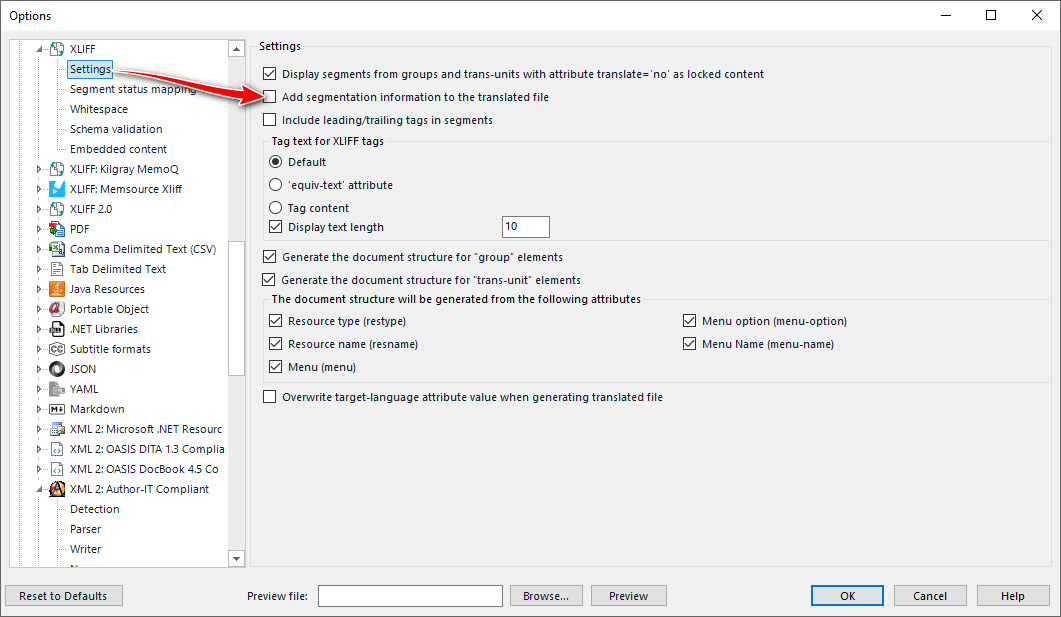
    Based on the error message you've received, it seems like the issue might be related to the 'Add segmentation information to the translated file' option in Trados Studio. MadCap Lingo might not recognize segmentation information, which could be causing the error. Here are the steps you can follow to resolve this issue:

    Step 1: Open your project in Trados Studio.

    Step 2: Navigate to the project settings.

    Step 3: Look for the 'Add segmentation information to the translated file' option and uncheck it.

    Step 4: Save the changes to your project settings.

    Step 5: Recreate your project and pre-translate the file.

    Step 6: Save the target file again.

    Step 7: Return the newly saved target file to your client.

    Please note that these steps are based on the assumption that you are using Trados Studio 2019, as the exact version was not specified in your question. If you are using a different version, the steps might vary slightly.

    I hope this answer addressed your question. If not, please reject the answer, add the question improvement suggestion information, and click the RWS Community AI checkbox on the right to try again.

    RWS Community AI

    emoji
  •   

    have you tried looking at the trans-unit in a text editor to see what might be causing the problem? The message seems quite specific.

    Paul Filkin | RWS

    Design your own training!
    You've done the courses and still need to go a little further, or still not clear? 
    Tell us what you need in our Community Solutions Hub

    emoji
  • Hi Paul, it seems it's a global issue for all files of which there are quite a few. Do you have any other ideas as to what the issue might be, please? Thank you! 

    emoji
  •  

    Without seeing the full error message behind the generic object reference error title, and without seeing a sample of a file I can only guess.  Maybe make sure you don't have this option checked?  Most tools I have come across that work with XLIFF don't know what to do with this information and that could be the cause of a problem?

    Screenshot of Trados Studio options menu highlighting XLIFF settings with a red arrow pointing to 'Segment status mapping' option.

    Paul Filkin | RWS

    Design your own training!
    You've done the courses and still need to go a little further, or still not clear? 
    Tell us what you need in our Community Solutions Hub

    emoji


    Generated Image Alt-Text
    [edited by: RWS Community AI at 3:17 PM (GMT 0) on 11 Mar 2025]
  • Hi Paul, we've tried sending a TMX to the client which they said worked quite well but they need the metadata to contain the source and target information. Is there a way of tweaking the settings when we export to TMX to include this? I have a screenshot but it contains information about the client so can't share it on the forum. Many thanks. 

    emoji
  •  

    I'm afraid I'm now quite confused.  You translated XLF files and now send a TMX that needs source and target info in the metadata?  I can't help feeling you are probably missing something far more obvious to solve your problem and without seeing your files we'll never know.

    If it helps, and if your client will accept it, you can send files to me through pfilkin at sdl.dotcom.  I'd happy to try and help you solve this problem, but the way we are doing it in here may be missing a far easier solution.

    Paul Filkin | RWS

    Design your own training!
    You've done the courses and still need to go a little further, or still not clear? 
    Tell us what you need in our Community Solutions Hub

    emoji