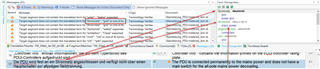
With "largish" documents I get hundreds (sometimes thousands) of false positives for Term Recognition, how can this be reduced to a manageable level? Changing the "Fuzzy match level" does not help very much.
You are currently working on UAT

With "largish" documents I get hundreds (sometimes thousands) of false positives for Term Recognition, how can this be reduced to a manageable level? Changing the "Fuzzy match level" does not help very much.
Can you share some examples of what you are getting compared to what's in your termbase?
Paul Filkin | RWS
Design your own training!
You've done the courses and still need to go a little further, or still not clear?
Tell us what you need in our Community Solutions Hub
Can you share some examples of what you are getting compared to what's in your termbase?
Paul Filkin | RWS
Design your own training!
You've done the courses and still need to go a little further, or still not clear?
Tell us what you need in our Community Solutions Hub
I expressed the problem a little ambiguously.
The main problem is with endings, such as "determines", "determined"
and where the TB contains a noun such as "application" but the related verb, such as "applied" (I find this occurs frequently in DE-EN). What settings are most appropriate in such cases?
I have a related problem when I have concatenated TBs. The QA does not seem to reference the second TB - is there some related setting?
it looks quite logical to me
Hi Anthony Rudd
AFAIK this is a shortcoming of the existing MT integration in Studio: https://community.sdl.com/ideas/translation-productivity-ideas/i/trados-studio-ideas/when-checking-for-non-usage-of-target-terms-accept-if-one-target-term-is-used
Daniel