 Translate



Hi everyone
I would like to know if there is a way to find inconsistencies (in target) in a TM (could xbench be of any help??).
Any advice is welcome :)
Xavier
You are currently working on UAT

Hi everyone
I would like to know if there is a way to find inconsistencies (in target) in a TM (could xbench be of any help??).
Any advice is welcome :)
Xavier


Paul Filkin | RWS
Design your own training!
You've done the courses and still need to go a little further, or still not clear?
Tell us what you need in our Community Solutions Hub
You can search for potential duplicates like this:
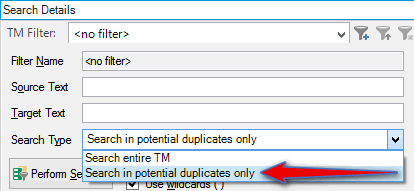
Don't enter anything, just select this option and "Perform Search". This will list same source different target results with a separate page for each one.
Paul Filkin | RWS
Design your own training!
You've done the courses and still need to go a little further, or still not clear?
Tell us what you need in our Community Solutions Hub

Paul Filkin | RWS
Design your own training!
You've done the courses and still need to go a little further, or still not clear?
Tell us what you need in our Community Solutions Hub
ah, you are right.
i found it.
thanks.
-minor inconvenient thing.. I have to click more than "200" times. that's a quite labor.
sounds like that is the real dark side of it.
if it still has Fields problem, forget about it. Period.
it says its latest version is "2009 April 29"
oh, that's enough
I don't really know, to be honest... never needed to care about this for my purposes. And since I moved from the loc industry (working again with bosses/owners who DO have a clue is so relieving!), I don't have much chances for further experiments.Alison Field said:I'm interested to know if it is now possible to work on tmx files in Olifant without losing the TM field properties?
Are you under 20, considering everything older than one week to be "out"... or what?Martin Jornan said:it says its latest version is "2009 April 29"
oh, that's enough
i have tested that "2009" Olifant
it recognizes all fields of SDL Trados Studio correctly.
that is good enough.
but, if you want to use them (my sdltm has lots, lots of fields) again,
you have to make all and every of them "Again" when you import it into SDL Trados Studio.
that is pure nonsense.
so, i guess, field problem lies at SDL's "2017" side.
i do not think it's a bug, it's just another difficulties.
i could be wrong, because i have used Olifant less than 5 minutes.
if you know better idea about it tell me, i'll check it out, for sure.
And, Do not mention others age like this, that is dirty attitude.
In short
I am not going to use the old "Olifant"
In itself it works well. But, it's not good at with SDL Traods Studio 2017.
Martin Jornan said:but, if you want to use them (my sdltm has lots, lots of fields) again,
you have to make all and every of them "Again" when you import it into SDL Trados Studio.
that is pure nonsense.
This is not really nonsense. The problem with using TMX is that it lists all the fields you used for that TMX but it carries no information about what should actually be in the TM. For example, your TM could be set up for 5 different types of fields and 10 different possible picklist values in each field. The TMX export may not actually contain all the fields or all the values so when you share that TMX with someone else they will not get the same TM as the one you have.
Maybe make use of a Language Resource Template and then you will be able to recreate your TMs quickly and reliably?
Martin Jornan said:And, Do not mention others age like this, that is dirty attitude.
I don't agree with this. TMX is a really old exchange filetype that has been used for decades and it hasn't changed for around a decade. So why wouldn't you use a piece of software that was designed to handle old formats like this if you see fit? I've played a round with Heartsome and it has some good qualities, but I still find Olifant to be more stable than that despite its age. It's still used as part of the Okapi framework by many localization engineers today.
Paul Filkin | RWS
Design your own training!
You've done the courses and still need to go a little further, or still not clear?
Tell us what you need in our Community Solutions Hub