Alignment of XLIFF files fails without error message

Passolo 2016 with .NET
Cascaded project:
-- LPU1, (en-us1 -> en-us2)
-- LPU 2 (en-us2 -> 12 targets, including German)

My project wants to from PO files to XLIFF in the hope of easier updates, thanks to IDs.

Steps so far:

  1. I have successfully added the XLIFF en-us>1 source to LPU1, validated the translation (identical, for now) and saved LPU1.
  2. Opened LPU2 updated/created source and 1 of the targets, namely German, just to test.
  3. Now trying to align LPU2/German with the existing translations in an identically structured German XLIFF file.
    1. Opened the German target string list (there is only one)
    2. Selected from menu: Scan Target File  (Alignment)
      Now in popup:
    3. Apply to --> Translation list myResource German (Germany)
    4. Align > this file > I selected the German.XLF file
    5. Language to extract shows grey [Select a language]  Note: German is not offered, although the XLIFF file specifies target language = de
    6. Options set:
      1. Align all
      2. Overwrite existing translations
      3. All strings in the target file are translated
    7. Click OK
  4. Nothing happens. No error message.

Any ideas what is happening. I enclose the En and the DE  XLIFF files.

Parents Reply Children
  • Many thanks, as ever, Mr. Herrmann!
    I will try out your suggestions and verify the answer ASAP. 

    I suspected and tried the source-language "en" myself yesterday, but only in LPU2. This time I will try from scratch (LPU1, LPU2).

    Am I correct in saying that the target-language name is less critical, and not used at all if each alignment file contains only one target language?
    If I am NOT correct, where can I find a list of the language abbreviations that Passolo permits? Note that we have 2 variants of Chinese, and there seem be variant naming schemes, e.g. zh-tw, zh-hant etc.

  • I confirm that changing the source language to from "en_devel" to "en" fixes the alignment problem.  The target language in the dialog window is always displayed as English (i.e. the source), but in fact the translations FROM English are imported.

    I will have to get back to you on the Notes/Comments xmlns change. I have forwarded your fix to the SW-developers on the assumption that they will know where to edit.

    Thanks again.

  • If you'll permit me another quick XLIFF import question here:
    The main stringlist window is displaying apostrophes, double quotes etc. in "&" syntax, e.g. Can't instead of   Can't  (as in the XLF file).   
    Nevertheless, in the properties widget, in menu:View>Show Resource, AND even in the stringlist window when you select a cell, the display reverts to Can't .

    Now the "&" syntax makes languages like English and French hard to read.  Is there any way to suppress the "&" syntax display generally in the stringlist window?

  • This is by design. Conversion into entities happen, when the Microsoft MSXML component is reading the file. In the list Passolo always display the raw data while it converts it back into for the editing window.  

  • Thanks. OK, noted, but that design decision makes it very difficult to skim through translations quickly in the string-list window. You have to click in each cell to make it readable.  it would be nice if it were the other way round, or optional (e.g. a toggle-able display).
    French, English, and any strings containing single or double quotes are particularly badly affected.

    Maybe one for the backlog? ;-)

  • Hi again,
    I have been unable to verify the suggested fix for importing XLIFF notes as passolo comments.
    I have done the following, with many slight variations but all to no avail:


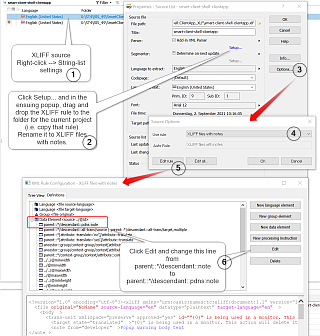
    1) Open LPU1
    2) Right-click the XLIFF source and select String List Settings --> Properties Source List popup appears
    3) In the popup the Parser is listed as "Add-in XML Parser". Click Setup... --> XML Parser Settings popup appears
    4) Drag XLIFF rules from Default rules to the Project
    5) Select the XLIFF rules in the project and renamed to XLIFF with notes
    6) Select the renamed XLIFF rules in the project and exported it to an xfg file
    7) Opened the xfg file in Notepad++ (NOTE: XML parser warns that UTF-16 is declared in the header, but contents are UTF-8)
    8) Edited the xfg file as described by you, so the relevant text reads descendant::pdns::note
    9) Saved the xfg file
    10) back in the popup, select "XLIFF with notes" rules and the project, and imported the edited xfg file.
    11) sub-popup wants me to select which rules I want to import, I select all. --> Now the Custom rules folder is also full of copied rules!
    12) Left popup with OK and tried to generate/update string list.
    Result: No change,  the Comment fields are still not populated.


    Please can you tell me what I'm doing wrong and give the correct steps in detail.  I cannot find them in the documentation.
    Thanks in advance.

  • Problem solved with Peter by changing some project and XML rule settings.

  • Correct.
    Sorry -- I could not upload the full sized PNG, but maybe this helps.
    Screenshot of Trados Studio showing a project settings window with a highlighted error message 'Failed to load the file' in the XMLXLIFF settings tab.

    emoji


    Generated Image Alt-Text
    [edited by: Trados AI at 5:46 AM (GMT 0) on 5 Mar 2024]
  • I am having same/similar problem. I have setup according to this thread. What should it look like in the incoming XLIFF file? I want to have two custom fields coming in from XLIFF and don't know how to define XFG to get to work. 

  • Many years ago, Microsoft had a quite nasty bug in their MSXML components that are used in the background by Passolo to read and write XML files. This bug was related using XML namespaces like this:

    Screenshot of an XML file with XLIFF version and encoding details, displaying an error symbol next to the namespace declaration.

    Result of this bug is that the content of some XML elements can’t be imported into the Passolo projects. The development team has overcome this problem by defining and implementing a special namespace indicator called pdns. More information see here.

    When this additional keyword is used in XPATH expressions the Microsoft bug be fixed. Unfortunately this has to be done for each and every rule. As an example the XLIFF meta data for <context-group> XPATH expression must be changed from

    parent::*/context-group/context/attribute::context-type | parent::*/context-group/context,valueid

    to

    parent::*/pdns:context-group/pdns:context/attribute::context-type | parent::*/pdns:context-group/pdns:context,valueid

    emoji


    Generated Image Alt-Text
    [edited by: Trados AI at 5:46 AM (GMT 0) on 5 Mar 2024]