Could anyone please explain why do I need Passolo

I mean, since Passolo exists, I assume it must have some specific advantages in comparison with Studio. So far, when I get a job in Passolo, I ask my client to convert their Passolo files into a Studio-compatible format and I translate them all with Studio. However, since Passolo was developed for a purpose and is sold and bought for a reason, then there must be some major benefits or something that makes people buy and use this product. So, my question is: is there any video available showing Passolo workflow or article(s) describing why I need Passolo? I am asking because I want to understand if it is worth my time (I mean learning time I need to spend to switch from half-professional 'Studio-converted' method/workaround to fully professional 'Passolo-native' method/solution). Thank you.

  • Hi

    I know you are asking for videos or articles, but I can tell you one clear reason why Passolo is necessary.

    In Passolo, all strings are managed by parameters such as source paths, source file names, string IDs, source text, etc. All these parameters can be used when legacy translation is leveraged, i.e. all legacy strings are not being simply translated using TM, rather they are leveraged using all or any of those parameters and you can choose which parameters should be used.

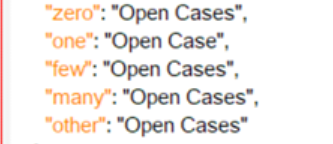
    For example, there are plural forms and some languages will require the following plural forms translated uniquely. In non-Passolo workflow, TM will be applied to source text "Open Cases" without context re: how many cases translation is for, and translation will be the same for all "Open Cases." This could result in inaccurate translation. 

    In Passolo workflow, string ID such as "zero" and "few", etc. can be used as parameters and apply the correct legacy translation for each "Open Cases" source text. In many target languages, they should be translated differently.

    Screenshot of Trados Studio showing plural forms parameters for the source text 'Open Cases' with string IDs 'zero', 'one', 'few', 'many', 'other'.

    in certain industries such as life science where FDA approvals are important part of software development, maintaining legacy translation correctly is a must. 

    I hope it helps.

    Thanks,

    Naoko

    emoji


    Generated Image Alt-Text
    [edited by: Trados AI at 5:34 AM (GMT 0) on 5 Mar 2024]
  • Naoko-san, thank you for your input.
    It seems I have never received jobs with such parameters (but I understand what you mean—this is relevant for the Russian language). When I tried using Passolo directly, I only had a simple text editor lacking all useful features (like termbase, autosuggest, etc.) that I have got used to. That's why I am trying to assume now whether learning Passolo is worth the effort. Thanks again.

  • Just to add to that very important advantage on Passolo being ID-based from  you also have the obvious:

    And much more... if you review the help it'll give you some idea. It really is a specialists tool and when used in conjunction with externals like these the functionality is extended even further:

    Why you need Passolo... only you can answer that one as we have no idea what you actually do?

    Paul Filkin | RWS

    Design your own training!
    You've done the courses and still need to go a little further, or still not clear? 
    Tell us what you need in our Community Solutions Hub

  • Ok, it's getting clearer now. Thank you for the links. Will check them.